 Without access to care, blurry vision can ripple into everyday life, making workplaces less safe, causing students to fall behind in school and make opportunities easier to miss. It’s an everyday reality for neighbors with barriers to care, such as transportation, finances and insurance coverage.
That’s where two Wake Forest University School of Medicine students saw a need to connect the community with resources for better eye health.
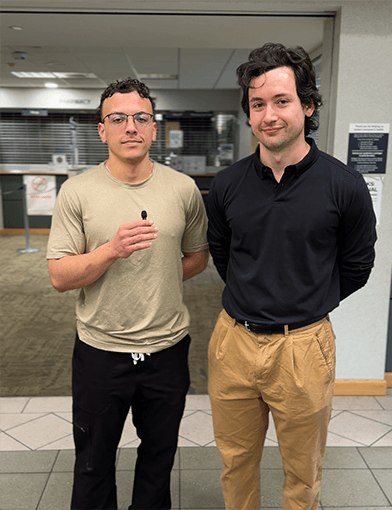
In spring 2024, MD Program students Walter Duy and Pinyu Chen launched Project Screening Eyes and Education (SEE) to bring free vision screenings, prescription glasses and access to ophthalmology expertise, directly to the community. After they graduated in 2025, MD students Jaelen King and Avery Kerwin took over Project SEE and have co-directed it for the past year.
“Over the past year, during the free vision screenings we’ve provided, the stories we’ve heard have been heartbreakingly consistent; ‘I’ve never been to an eye doctor, I don’t have insurance, I can’t afford to take time off work, I couldn’t find transportation,’” says King, who is pursuing a career in primary care. “These aren’t excuses — they’re barriers. And for people whose jobs already put them close to hazardous tools, chemicals, machinery and fast-paced environments, the ability to see clearly can be the difference between going home safely and not going home at all.”
“Vision matters for how children learn, interact and function,” says Kerwin, who hopes to pursue a career in ophthalmology. “This disconnect between coverage, diagnosis and actual care is what I call the ‘vision gap’ — a form of preventable visual impairment that affects educational progress and well-being.”
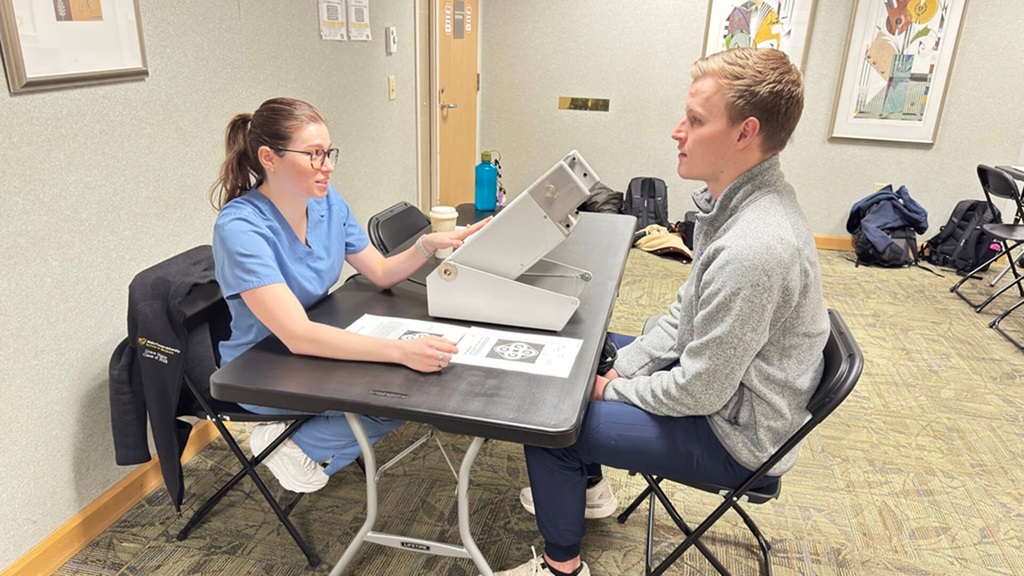
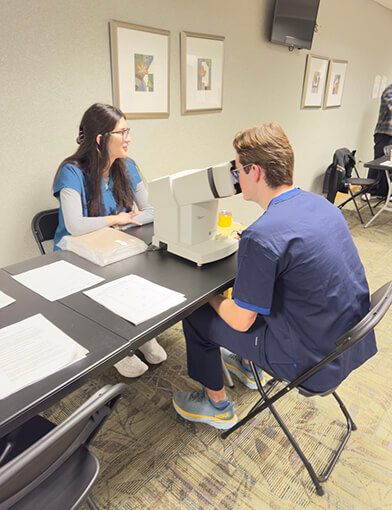
With help from their medical school classmates, King and Kerwin host screening events multiple times a year for adults and children, at no charge. These screenings assess eye health and visual acuity, and each attendee who needs them receives a free pair of prescription glasses.
 Registration is not required, and attendees can simply show up at the event to receive a screening. The events are typically held at the Atrium Health Wake Forest Baptist Downtown Health Plaza, in Winston-Salem.
“At our screenings, when someone realizes we are going to order a new pair of glasses for them, for free, suddenly their entire face lights up and you realize just how transformative something so simple can be,” says King.
“A pair of glasses doesn't fix every challenge but it helps remove one major barrier,” Kerwin says.
The initiative is part of the Schweitzer Fellowship, a year-long community service fellowship focused on addressing gaps in health care access.
The initiative has been generously supported by numerous community partners, including Northwest AHEC – which provided pilot funding, allowing for the purchase of eyeglasses – Monica Brown, associate director of Downtown Health Plaza, and the Department of Ophthalmology at Wake Forest University School of Medicine. All clinical activities for Project SEE are overseen by the Department of Ophthalmology to ensure quality care and appropriate guidance.
Project SEE’s benefit to the community is crystal clear: Since May 2025, more than 250 adults and children have received free vision screenings, with about 100 of them going home with free prescription eyeglasses. In addition, over 20 total participants have been referred for follow-up care.
Project SEE is also providing hands-on skill development and community service experience for Wake Forest University School of Medicine students, as 37 medical students have been trained to provide eye exams.
 “Vision is such an important part of our lives and it’s easy for us to take for granted,” says Kerwin. “We’re doing something that’s very tangible in terms of impacting the community.”
“We’ve received messages back of ‘I can see now,’ and that’s a really rewarding and fulfilling thing that we’re serving our community in that way,” says King.
The next Project SEE clinics will be a pediatric clinic, for children 18 and under, on Saturday, April 18, and an adult clinic on Saturday, May 9, both at Atrium Health Wake Forest Baptist Downtown Health Plaza.
Capacity is limited, so participants will be seen on a first-come, first-served basis.
Visit here to learn about future events, as they are scheduled.


