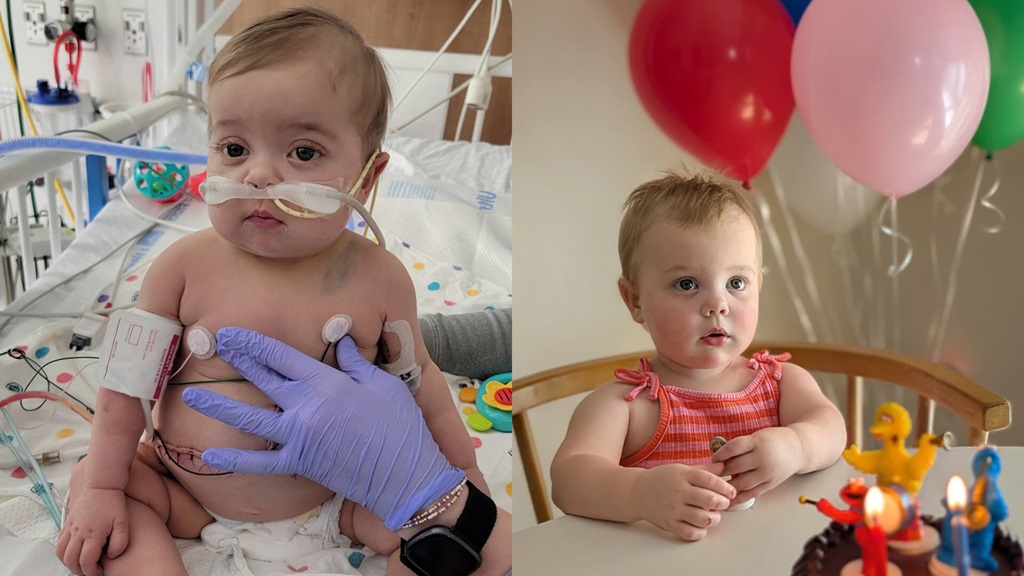
“She’s silly, strong and spunky,” says her mom, Barbara. “She makes us laugh every day.”
Daphne loves going toe‑to‑toe with her big sister Heidi, creating her own dance parties and mothering her baby dolls.
“You would never know what she’s been through,” says her dad, Ben.
It’s hard to imagine that just a year and a half ago, Daphne was critically ill and waiting for a liver transplant that would save her life. Diagnosed with biliary atresia at 2 months old, she underwent surgery and months of intensive treatment before becoming Atrium Health Levine Children’s Hospital’s first pediatric recipient of an ABO‑incompatible liver transplant. Through it all, her gastroenterology team guided her care, and her parents stayed by her side through every setback and milestone.
Today, Daphne is doing what toddlers do best: exploring, growing and showing little sign of everything she has overcome.
An early diagnosis
 Barbara and Ben first noticed something was off when Daphne was about a month old. Her skin had a yellow tint, a sign of jaundice. At her 2‑month checkup, her pediatrician recognized the change and referred her to a gastroenterologist. A week of tests followed, eventually bringing the family to Levine Children’s Hospital, where surgeons performed an intraoperative cholangiogram to examine her bile ducts.
The results confirmed biliary atresia, a rare condition in which bile ducts become blocked or fail to develop properly. Without a way for bile to drain, it builds up and damages the liver.
Daphne’s first treatment was a Kasai portoenterostomy, a surgery that creates a new pathway for bile to flow. For a short time, it worked. Her jaundice improved and her lab results looked promising. But within weeks, her parents noticed pale stools, a return of jaundice and swelling in her abdomen.
“The bile did not drain, and that caused the liver to become damaged,” says Mary Alice Boulware, CPNP, a pediatric gastroenterology and hepatology provider at Atrium Health Levine Children's Gastroenterology, recognized by U.S. News & World Report as a ‘Best Children's Hospital’ for gastroenterology. “As the scarring progressed, she developed fluid accumulation, malnutrition and worsening jaundice.”
The fluid buildup made it difficult for Daphne to eat and gain weight. Her medical team tried medications to manage the swelling, but her condition continued to decline.
Waiting on a donor
 In January 2025, Daphne returned to Levine Children’s Hospital for another evaluation. But instead of going home, she was admitted. Her liver disease had progressed to the point that she needed intensive treatment and close monitoring.
“We could tell she wasn’t doing well,” Barbara says.
Daphne required IV diuretics and albumin infusions to manage the fluid in her abdomen. Her bilirubin continued to rise.
“It was clear she would not be stable to be discharged home without a new liver,” Boulware says.
Her parents tried to balance life at the hospital with life at home, where Heidi had just started kindergarten. The uncertainty of the wait was difficult, and Daphne’s condition continued to worsen. Her breathing became irregular, and she was moved to the pediatric intensive care unit (PICU).
“I was sobbing when they put her on a ventilator,” Barbara says. “That was the first time I thought, ‘This is really bad.’”
Daphne reached the highest level on the transplant priority scale. Her team needed to find a donor quickly.
“Despite being at the top of the transplant list, we had not found a suitable donor, and she was becoming sicker each day,” Boulware says.
Then a potential donor became available, and the match presented an unusual opportunity. Typically, liver transplant recipients receive an organ from a donor with a compatible blood type. Daphne’s team was considering a transplant from a donor with a different blood type, known as an ABO‑incompatible transplant.
With an ABO‑incompatible transplant, antibodies are removed from the recipient’s blood before surgery to help prevent rejection. The approach also expands the pool of available donors, which was critical for Daphne.
On Feb. 20, 2025, Daphne underwent the transplant. For her parents, the day brought a complicated mix of emotions. They were grateful for the chance to save their daughter’s life while recognizing the loss another family had experienced.
A long road home
 After surgery, Daphne remained in the PICU as her body recovered. She had been critically ill for weeks, and it took time for her to come off the ventilator and regain strength.
Her parents faced another challenge as she recovered from the medications she had received during her hospital stay. Managing withdrawal symptoms and adjusting her medications made the early days especially difficult.
“It was harder than letting her go into surgery,” Barbara says. “She was right in front of you, and you could see she was in pain.”
Daphne’s liver recovery progressed steadily, but she needed time to rebuild her strength and return to feeding by mouth. On March 13, nearly a month after her transplant, she went home.
Leaving the hospital was a milestone, but it also meant taking on a new set of responsibilities. Her parents managed a complex medication schedule, cared for her feeding tube and took precautions to protect her while her immune system was suppressed.
“In the hospital, you have all these professionals helping you,” Ben says. “Now it was on us.”
Over time, Daphne regained her appetite and no longer needed her feeding tube. She returned to the ordinary milestones of childhood, including walking, talking and lighting up a room.
“At one of our recent appointments at Levine Children’s, Daphne was dancing around the room with the lights off to Hilary Duff’s ‘What Dreams Are Made Of,’ waving a glow stick,” Barbara says.
A little girl with big plans
 Daphne will need ongoing medication to prevent rejection and regular monitoring to make sure her liver continues to function well. She still has occasional biopsies and blood tests, and her care team continues to watch for complications.
“We will continue to monitor her every three months with labs and clinic,” Boulware says. “She is doing so well.”
Her parents are learning to balance the realities of her medical history with the desire to let her be a typical toddler.
“She has a scar from her transplant, and we want her to be confident and proud of it and what she’s been through,” Ben says.
For Boulware, watching Daphne’s transformation has been one of the most rewarding parts of her work.
“It has been amazing to watch her change from a jaundiced infant with multiple medical complications to the sassy, charismatic, funny toddler that steals our hearts with every clinic visit,” she says.
Her parents take things one day at a time, with a simple hope for Daphne: a long, healthy life filled with opportunities to grow, learn and discover what she loves. For now, she’s doing what she does best. Moving forward, full speed ahead.
Learn more about pediatric gastroenterology and hepatology care at Atrium Health Levine Children’s.


